
Five reasons NOT to choose VPInstruments (and when you actually should)
A practical guide to choosing the right flow measurement technology, especially when your application is outside our sweet spot.
Introduction
We’re often asked a straightforward question: “Can you measure this flow?” In many cases, the answer is yes, especially when it comes to compressed air and industrial gases. But the more important question is: Should you use a VPInstruments flow meter for your application?
To help you choose the right technology (and the right supplier), here are five clear situations in which VPInstruments may not be the best fit, plus what to consider instead.
Where VPInstruments typically fits best
Our flow meters are designed for reliable, accurate gas flow measurement in industrial environments. Typical applications include:
- Compressed air (both saturated and dry, from supply to demand side)
- Nitrogen, argon, CO₂, and other industrial gases
- Welding and packaging gas mixtures
- Helium use in laboratories (e.g., leak testing and consumption monitoring)
If your application looks like the list above, you’re likely in our core use case. If not, read on.
1) You’re measuring liquids (water, cooling water, oil)
VPInstruments focuses on gas flow. If your challenge is liquid flow, such as cooling water, process water, or oil, other measurement principles can be a better match.
Depending on the situation, you may want to consider:
- Clamp-on ultrasonic flow meters for non-intrusive measurement on existing piping (often used for water). Look at U-F-M.nl for good examples of these products. You can also find “heat meter” types, which are great for cooling water applications.
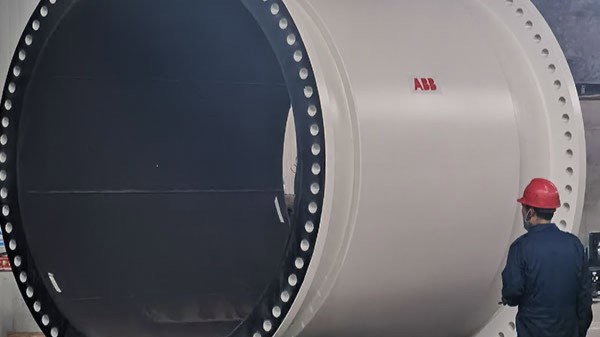
- Magnetic inductive flow meters for conductive liquids (common for many water applications; less suitable for demineralized water where conductivity is very low). For example Bronkhorst, Krohne and ABB (see picture) supply these products in various sizes, from 1 inch to “big-ass sized” DN3000 municipal water meters, in which you can literally walk, or swim (when not filled with water, or in case you are Ethan Hunt).
- Microfluidic / very small liquid flow measurement for medical, lab, or high-precision dosing applications. Go to Bronkhorst, they are experts on microfluidics, for example with micro-coriolis technology Or check Sonotec.de. They make special low-flow devices for non-intrusive (medical) hose applications.
The key takeaway: liquid flow measurement has its own set of proven technologies, so start there rather than forcing a gas-optimized solution into a liquid application.
2) Your gas flow is extremely low (laboratory-scale)
Some applications require measuring extremely small gas flows, think fractions of a liter per minute in R&D setups, micro-dosing, chip manufacturing equipment, or specialized lab tooling.
In those cases, dedicated low-flow instruments as manufactured by Bronkhorst, Alicat, Burkert, MKS or Voegtlin are often the better choice. And if you want to go for a lower cost solution, you might check out SMC or Norgren for pneumatic flow meters.
At VPInstruments we typically target industrial flow ranges and installations (for example, in-line and insertion meters in common pipe and hose diameters), so ultra-low-flow lab ranges may be outside our ideal operating window.
3) You need an ultra-fast response time
Response time can be a make-or-break specification in certain control loops and dynamic processes. Our instruments are designed for stable industrial measurement and typically use standardized sampling: making them excellent for monitoring, auditing, and optimization, but not always the best option when you need the fastest possible response.
If your application truly demands very fast dynamics, it may be worth evaluating alternative principles (for example, certain differential-pressure based solutions from Alicat, or small pneumatic flow sensors from SMC). Also note: “response time” is not always defined or specified consistently across suppliers. Some sensors have built-in filters which are default set to 1 second averaging. Others can enable high-speed mode to show ten or more updates per second. And another tip: the response of the sensor is influenced by pipe length between sensor and consumer. Long pipes will act as capacitors, smoothening out the pulsations. This is a way to use a “slow” flow meter for a “fast” process.
4) Your main selection criterion is the lowest purchase price
If the primary goal is simply “the cheapest meter,” then VPInstruments may not be your first choice, and that’s intentional.
We develop and build instruments for accuracy, reliability, and long-term value. In practice, the lowest price option can become expensive when you include:
- Lower accuracy and less trustworthy decision-making (e.g., 5% of full-scale can be misleading depending on your operating point)
- Missing features in the initial quotation that later become paid options (outputs, protocols, probe lengths, accessories)
- Calibration and maintenance burden (including international shipping, customs paperwork, and downtime)
- Service calls, troubleshooting time, and support in general. We have learned our lessons and believe that high level customer service is key for long term success.
If you’re a distributor, auditor or service provider, this matters even more: a very cheap instrument that fails often can easily cost more in time, site visits, and reputation loss, than it ever saved in procurement.
5) You need non-intrusive measurement and can’t modify the pipe
Sometimes you simply can’t install an in-line or insertion flow meter, because the process can’t be interrupted, the piping can’t be drilled, or the hygienic / safety requirements prohibit intrusion.
In those cases, a clamp-on ultrasonic flow meter (As offered by U-F-M, Flexim or similar brands) can be the right choice. Just keep in mind the practical trade-offs: installation quality matters and can be challenging when dealing with rough pipe surfaces, paint layers and vibration.
Also, accurate measurement often still requires pressure (intrusive) and temperature compensation, to account for changing process conditions.
So… when should you choose VPInstruments?
If you want accurate, reliable gas flow measurement, especially for compressed air and industrial gases like nitrogen, argon, helium, carbone dioxide. Combine this with practical installation, rich diagnostics (including pressure, temperature and bi-directional flow), built-in data logging capability and strong technical support, then you are at the right place.
If you’re unsure, tell us about your application and constraints. We’ll be honest about fit, and if it’s not a match, we’ll point you toward the kind of technology that is.
Want help selecting the right measurement approach? Reach out to VPInstruments to discuss your use case.

 中国 (简体中文)
 UK (English)

