
Food industry compressed air: cut waste and risk
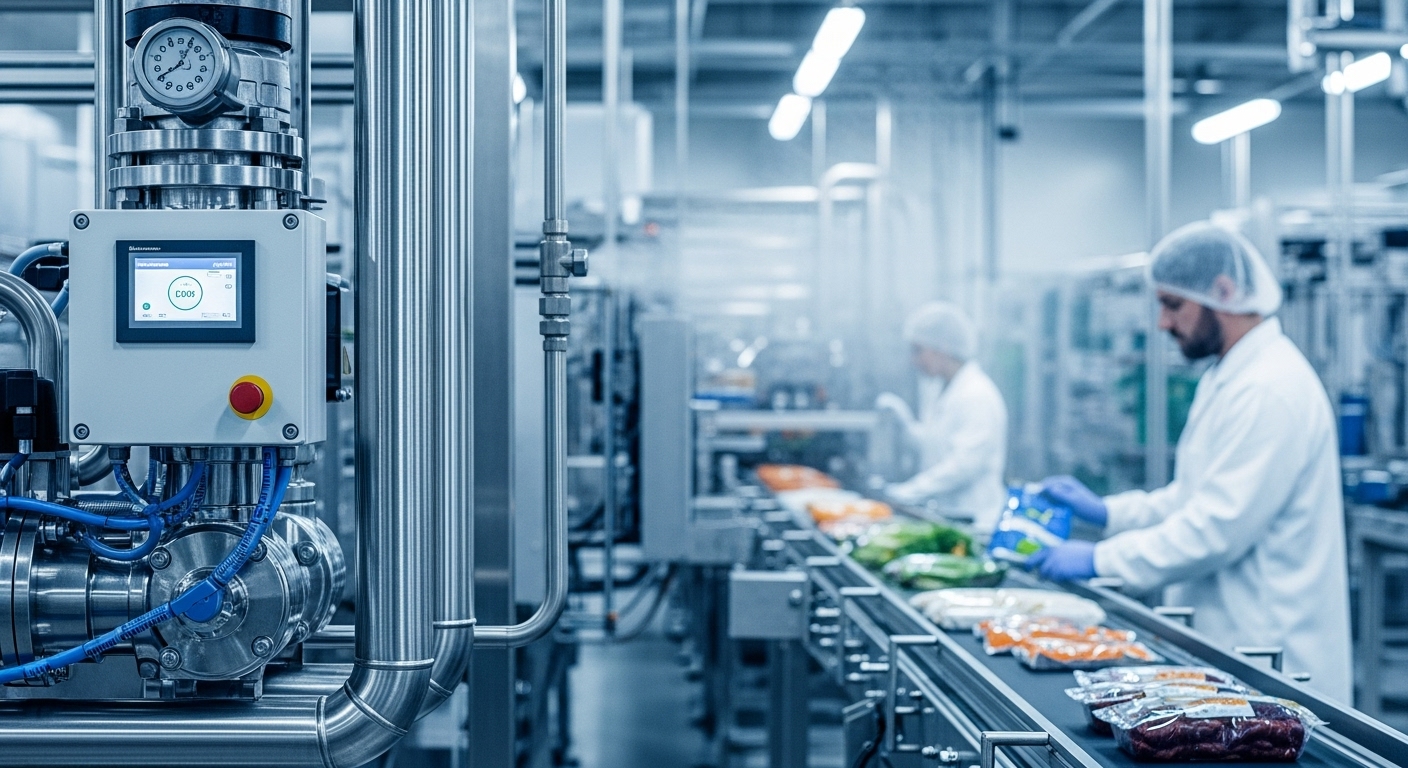
The food industry runs on compressed air and technical gases, yet many plants have limited visibility on where energy, money and CO₂ are lost. With right energy monitoring, you can quickly reveal waste, prevent contamination risks, and build a clear business case for improvements without overloading your team.
Food industry challenges in compressed air and gases
In food and beverage production, compressed air is often classed as a critical utility. It powers packaging lines, controls valves, supports cleaning-in-place and sometimes even contacts food directly. However, the real costs and risks are frequently hidden in your piping network and behind closed compressor room doors.
Many plants still estimate compressed air consumption instead of measuring it. As a result, undetected leaks, overpressure, poor air quality, and inefficient compressor control remain part of daily operations. At the same time, food safety, hygiene regulations and ISO 50001 expectations demand better insight and documentation.
Because your team is small and busy, projects that look complex or IT-heavy are easily postponed. Therefore, plug-and-play flow meters and energy monitoring solutions that integrate with your existing PLC or SCADA are essential. They provide reliable data with minimal installation effort and give you a simple dashboard for decision making.
From hidden losses to clear savings
Most food plants underestimate the share of compressed air in their total energy bill. Yet, when you monitor real consumption per line, department, or shift, you often discover that the system behaves very differently from design assumptions.
For example, baseline measurements can show that night-time consumption stays high while production is low. This usually points to leaks, open blow-off nozzles, or equipment left running unnecessarily. When you quantify these losses, it becomes much easier to convince management to fund maintenance and upgrades.
In addition, flow / pressure and power monitoring in the compressor room helps you check whether compressors are running efficiently as a system, not only as individual units. You can compare specific power, loading patterns, and pressure levels and then adjust the control strategy. Small changes in pressure or sequencing often produce quick savings with almost no risk to uptime.
By connecting meters to a central monitoring platform, you can also benchmark performance across multiple plants. In this way, best practices from one facility can be rolled out to others in a structured way, supported by hard data instead of assumptions.
Meeting hygiene and quality requirements
Food-grade compressed air must meet strict quality requirements for particles, water and oil. However, quality incidents are often only investigated after a complaint or audit finding. Continuous monitoring of air and gas flows helps you understand where the highest risks are and how system design choices affect product contact points.
When you know how much air is used for blow-off, drying or packaging, you can match this with filtration and dryer capacity. Therefore, you avoid undersized treatment stages that compromise quality, as well as oversized systems that waste energy. Furthermore, use dew point sensors downstream dryers to guarantee their proper functioning and use them right before critical processes to prevent product loss. Documented measurements also support audit trails and certification processes.
Moreover, monitoring helps you detect abnormal patterns that may signal contamination risks. Sudden changes in consumption at a critical application, for instance, can indicate a failed valve, damaged hose or incorrect manual adjustment.
Building an ISO 50001-compliant energy view
To comply with ISO 50001, you need to demonstrate control over significant energy uses such as compressed air systems. This requires an energy baseline, performance indicators, and evidence that you manage deviations. Automated monitoring makes this task much easier and more reliable than manual readings.
By installing sensors at key distribution points, you can define energy performance indicators per production area, product group or shift. This helps you separate process-driven consumption from system losses. It also allows you to compare similar lines and identify where best practices can be replicated.
Linking compressed air data with your production data creates powerful insights. For instance, you can calculate energy per packed unit or per batch. When this metric drifts, operators can act quickly instead of waiting for monthly energy bills. Over time, such indicators become part of daily management routines, supporting a true culture of continuous improvement.
Simple dashboards and automatic reports reduce the workload for energy and plant managers. Instead of collecting and merging spreadsheets, you can spend your time on analysis and concrete actions. To explore how multi-utility monitoring works in practice, see our solutions for energy monitoring systems.
Choosing plug-and-play monitoring that fits your team
When you select monitoring equipment for a food plant, technical performance is only one part of the decision. The solution must also fit your limited installation time, existing automation standards and internal skills.
Clamp-on or insertion flow meters reduce installation downtime because you avoid cutting pipes. Integrated totalisers and display options help maintenance teams verify readings locally. Standard outputs such as 4–20 mA, Modbus, or Ethernet make it straightforward to integrate with PLC, SCADA and existing energy software.
It is also important that meters and loggers are robust and easy to maintain in washdown areas. Clear diagnostics reduce troubleshooting time when a sensor is disturbed or wiring has changed. Furthermore, having one central platform for compressed air and other utilities simplifies training and daily use.
For many plants, the most powerful benefit is transparency. When operators and managers see live consumption and costs per area, behaviour changes naturally. This creates low-cost savings that add up quickly, long before you invest in large hardware upgrades. If you want to equip your lines step by step, you can start with a few metering points and expand later using the same platform, such as our VPVision monitoring system.
Turning data into action and ROI
Collecting data is not the end goal. Your monitoring system should directly support decisions about maintenance, capital projects and daily operation. To achieve this, focus on clear KPIs, alarms and reports that speak the language of both production and finance.
For example, alarms on abnormal base load or sudden peaks help maintenance teams prioritise leak detection and repairs. Trend reports make it easier to justify investments in more efficient compressors or pressure optimisation projects, backed by real numbers instead of estimates.
When you translate kWh savings into euro and CO₂ reduction, it becomes easier to align energy projects with corporate sustainability and budget targets. Over time, you can track payback of each action, from fixing leaks to replacing equipment, and use these results to plan the next steps.
In summary, food producers can significantly cut energy costs, lower CO₂ emissions and reduce operational risk by making compressed air and technical gases visible. With plug-and-play flow and energy monitoring that fits your existing systems, you gain the insight needed for quick wins today and a structured roadmap tomorrow. Explore our measurement and monitoring products to see how they can support your plant.

 中国 (简体中文)
 UK (English)

